Short Article By-Dreyer Kerr
If you have actually been taking into consideration SMILE eye surgery, you might wonder how it stacks up against LASIK and PRK. Each treatment has its own set of advantages and factors to consider. From quicker recuperation times to prospective risks, there are vital distinctions you need to be aware of before deciding. Comprehending https://click4r.com/posts/g/19114411/preventing-cataracts-through-everyday-to-way-of-life-modifications will certainly help you make an enlightened selection that lines up with your specific demands and expectations. Curious to understand even more about just how these treatments contrast in detail? Continue discovering to acquire a thorough understanding of SMILE, LASIK, and PRK.
SMILE Eye Surgery Summary
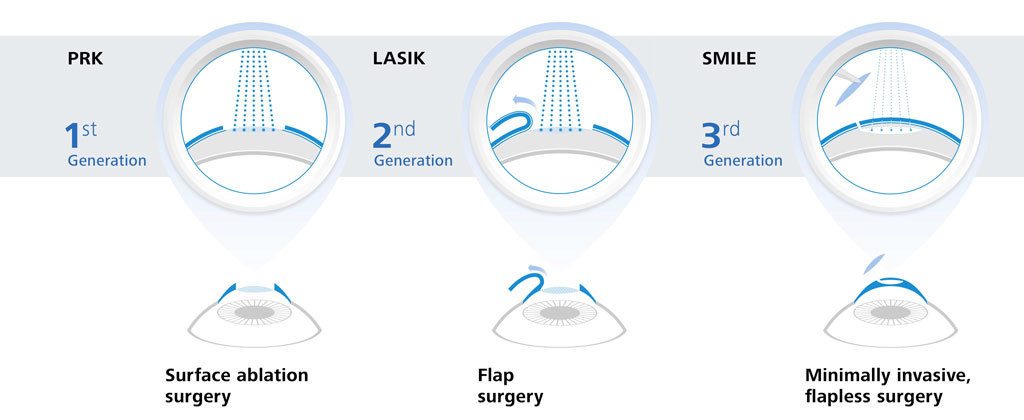
If you're taking into consideration SMILE eye surgery, you'll discover it to be a minimally intrusive procedure with a fast recovery time. During SMILE (Little Incision Lenticule Extraction), a laser is used to develop a little, exact incision in the cornea to get rid of a small piece of tissue, improving it to fix your vision. This varies from LASIK, where a flap is developed, and PRK, where the external layer of the cornea is entirely removed.
Among the crucial advantages of SMILE is its minimally invasive nature, resulting in a faster recovery procedure and less pain post-surgery. The recuperation time for SMILE is reasonably fast, with many individuals experiencing boosted vision within a day or two. This makes it a prominent option for those looking for a hassle-free and efficient vision modification procedure. In addition, SMILE has actually been revealed to have a lower risk of completely dry eye disorder contrasted to LASIK, making it a beneficial alternative for people concerned about this prospective side effect.
Distinctions In Between SMILE, LASIK, and PRK
When contrasting SMILE, LASIK, and PRK eye surgical procedures, it is necessary to understand the distinct methods used in each treatment for vision adjustment.
SMILE (Little Cut Lenticule Removal) is a minimally invasive procedure that entails producing a small laceration to draw out a lenticule from the cornea, reshaping it to correct vision.
LASIK (Laser-Assisted In Situ Keratomileusis) includes creating a thin flap on the cornea, using a laser to reshape the underlying tissue, and afterwards rearranging the flap.
PRK (Photorefractive Keratectomy) removes the outer layer of the cornea prior to improving the cells with a laser.
The main distinction lies in the method the cornea is accessed and dealt with. SMILE is flapless, making it a great choice for people with slim corneas or those involved in contact sporting activities. LASIK offers rapid aesthetic recuperation due to the flap production, but it might posture a higher risk of flap-related problems. PRK, although having a longer recuperation period, prevents flap-related concerns entirely.
Understanding these variations is essential in picking one of the most ideal procedure for your vision correction demands.
Benefits And Drawbacks Comparison
To evaluate the advantages and disadvantages of SMILE, LASIK, and PRK eye surgical treatments, it's vital to take into consideration the specific benefits and potential limitations of each procedure. SMILE surgery offers the advantage of a minimally intrusive procedure, with a smaller sized laceration and potentially quicker recuperation time compared to LASIK and PRK. It additionally minimizes the danger of completely dry eye post-surgery, a common adverse effects of LASIK. Nonetheless, SMILE might have constraints in treating higher degrees of myopia or astigmatism compared to LASIK.
LASIK surgical treatment gives quick visual healing and very little pain throughout the treatment. It's highly reliable in dealing with a variety of refractive errors, including nearsightedness, hyperopia, and astigmatism. Yet, LASIK lugs a threat of flap problems, which can impact the corneal structure.
PRK eye surgery, while not as preferred as LASIK, stays clear of developing a corneal flap, lowering the threat of flap-related difficulties. It's suitable for clients with slim corneas or irregular corneal surfaces. Nonetheless, PRK has a much longer recovery time and may entail much more discomfort during the healing procedure.
moved here , when it involves picking between SMILE, LASIK, and PRK, think about it like picking the best set of footwear. SMILE is like a streamlined, comfortable pair of sneakers - quick and easy.
LASIK is a lot more like stylish high heels - flashy and quickly, but with some potential threats.
PRK is like tough treking boots - trusted and long lasting, yet calling for a bit even more effort and time.
Eventually, the most effective option depends on your specific requirements and preferences.